

Introduction
Hey — thanks for being here!
If you’ve landed on this page wondering “What is an MES?” — we’ve got you covered.
MES stands for Manufacturing Execution System. Manufacturing whaaaat?! You may wonder.
Let me tell you — I had no clue what an MES was when I first started developing software as a college hire for a medical device company over a decade ago.
An MES is the integration of multiple technologies designed to enhance and assist humans in their manufacturing activities. MES systems are the essence of digital manufacturing. Many are built for specific purposes such as material management, machine connectivity, or electronic Device History Records (eDHR).
No matter what the purpose, an MES becomes the backbone of digital transformation throughout its lifetime in a manufacturing company. Implementations often last decades, which makes MES expertise a skill in high demand.
So, if you’re interested in developing yourself as an MES professional, sign up for our mailing list to receive more insights and topics like this one straight to your inbox.
What Does an MES Actually Do?
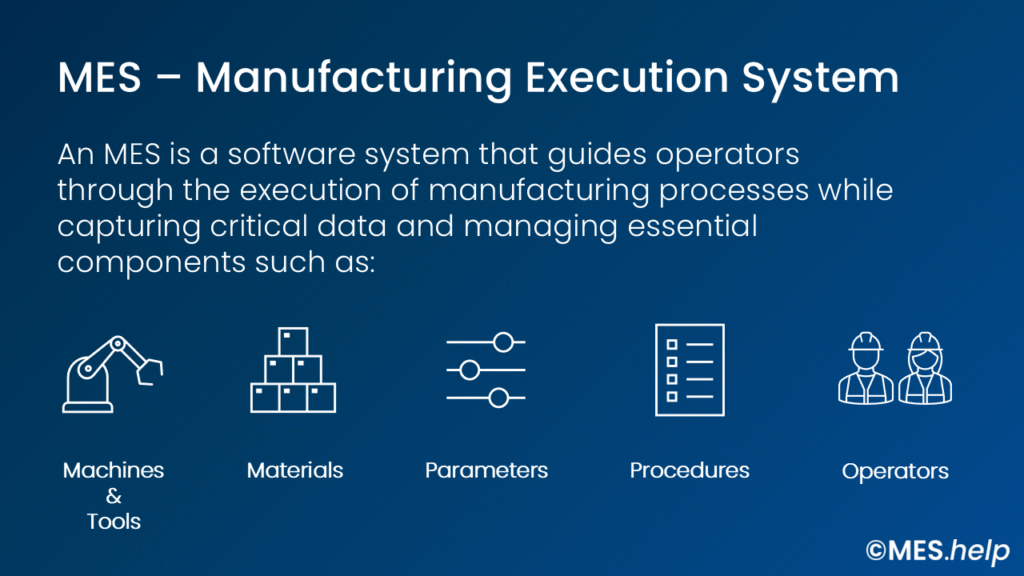
At its core, an MES is a software system that guides operators step-by-step through the execution of a process while capturing important data and details along the way.
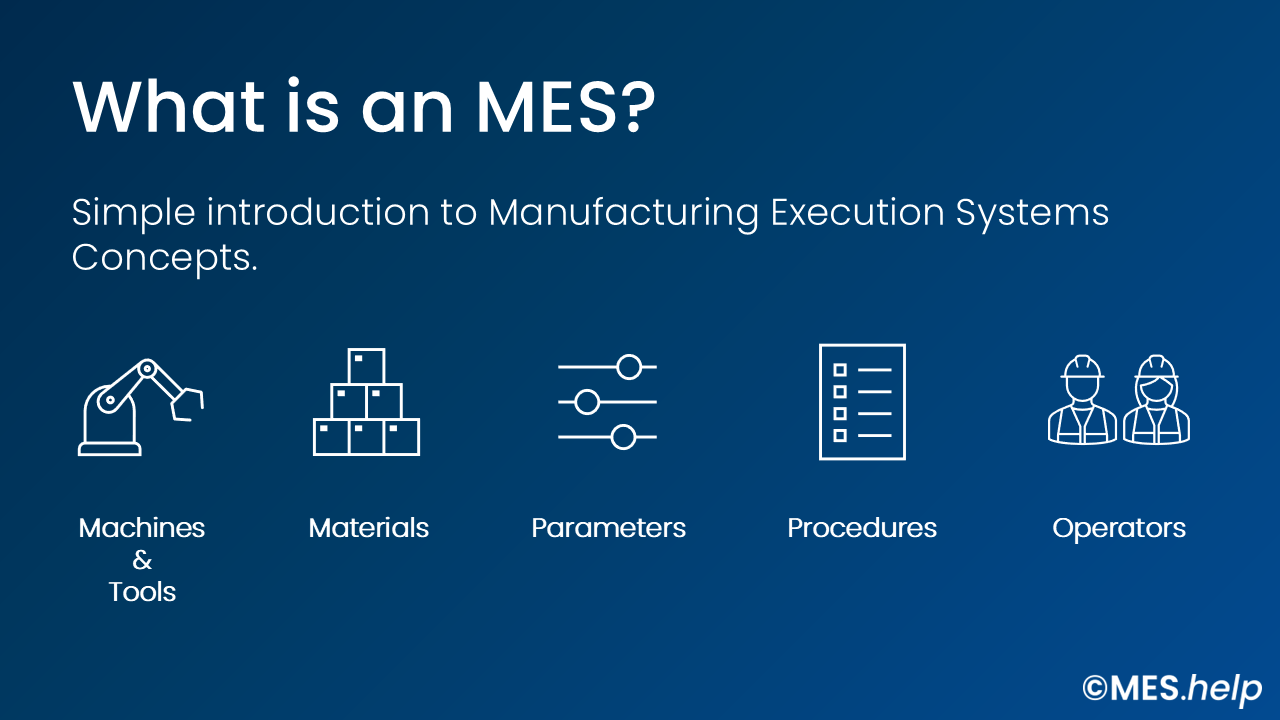
It helps create a digital representation of your manufacturing line, including all its main components:
- Manufacturing Operations
- Procedures
- Materials
- Equipment and Tools
- Resources
- Parameters
- Time
To visualize an MES system imagine an operator arriving at a production station, logging in, and starting an app that tells them exactly what to do. The system can display:
- What materials are needed
- Which tools to use for the operation
- The current quantity
- The target quantity to produce
- The product’s characteristics
MES implementations vary widely in complexity and functionality. Some focus mainly on material management, verifying and consuming materials, while others focus more on process execution, capturing operations time, quantity, and quality data.
MES Is a Concept, Not a Single Software
It’s important to understand that MES refers to a category of software, not a specific product.
There are many MES solutions on the market, each developed by different software providers. Most MES systems are designed for enterprise-scale manufacturing, but their design philosophies vary.
Some come with robust, pre-defined functionality that may require your process to adapt to their structure. Others act more like a blank canvas, allowing you to design and tailor the system to your specific operations.
Which one fits best? Well, as engineers like to say — it depends.
MES implementations vary widely in complexity and functionality. Some focus mainly on material management, verifying and consuming materials, while others focus more on process execution, capturing operations time, quantity, and quality data.
How MES Is Deployed
MES solutions can be implemented in several ways, including:
- On-Premises: Hosted and managed on the company’s internal servers and network.
- Cloud-Based: Hosted by the vendor or a third-party provider, reducing the need for local infrastructure.
- Hybrid: A mix of both — hosted in the cloud but with local components for secure connectivity to ERPs or shop-floor equipment.
Initial MES implementations come with a laundry list of things to consider — from shop-floor readiness, process maturity, regulatory requirements, workforce characteristics, process complexity, hardware needs, team expertise…… you get the picture.
An MES can be implemented for a single operation within a factory or scaled up to a full enterprise implementation that includes all lines, sites, and global regions.
Enterprise implementations enable vertical data channels that provide visibility across networks. Achieving that is hard — but not impossible. It won’t happen overnight, but in the end, it can enable automated decision-making that increases the efficiency of a global supply chain.
That’s the essence of the smart factory and digital transformation.
MES and Regulatory Compliance
I’ve worked my entire career in regulated industries, which adds an extra layer of complexity to MES implementation: Regulatory Compliance.
This is the last topic I want to cover in this short introduction — but definitely not the least important.
In regulated industries such as pharmaceuticals and medical devices, MES implementations must follow a System Development Life Cycle (SDLC). This includes planning, requirement gathering, design, testing, and validation to ensure the software meets its intended use.
And let me tell you — if you haven’t seen these regulatory processes before, they can be tough. Back in the day, I saw workflows that required up to 14 different documents, each with its own approval cycle, just to add a single button to an interface.
The good news is that things are changing. Many organizations now follow more efficient approaches to verification and validation while still maintaining compliance — in some cases reducing those 14 documents down to 5.
If you’re starting your first MES implementation, keep this in mind: based on my experience, building the app itself is only about 20% of the total effort required to deploy it successfully.
And if you’re in a non-regulated industry, here’s the takeaway: the quality of your solution will be directly proportional to the quality of your process. You might not be required to follow an SDLC, but your MES will absolutely benefit from having one. If you’re early in your implementation journey, you’re actually in a great position — you can define your own process, improve it over time, and build something truly scalable.
In Summary
An MES is the system that unifies people, processes, equipment, and data to make manufacturing more accurate, efficient, and reliable. It creates the digital foundation needed for traceability, quality, and real-time decision-making — ultimately powering true digital transformation.
I started this blog because I wish someone had broken MES down this clearly when I first entered the industry. Whether you’re an engineer, a digital transformation leader, or simply curious about how modern manufacturing works, my goal is to help you understand and design MES solutions with confidence.
Welcome to MES.help — your guide to modern, digital, compliant manufacturing. Stick around: in the next post, we’ll dive deeper into how MES really works behind the scenes.